

Knit Socks
With winter just around the corner, it’s time to pull those warm socks out of the closet again. That is, if you still have any, of course. If not, it’s high time to arm yourself with some wool and double-pointed needles. Follow the pattern, and before you know it, you’ll be sitting on the couch with two wonderfully warm feet!
Knitting socks is really one of those old-fashioned crafts, but how fun is it to knit your own socks?! With this cool pattern from Phildar, you can make two trendy pairs of socks that look gorgeous even in open-toed shoes. Of course, they’re also nice and warm, and you can style them to your own taste by choosing your favorite colors. Phil Folk, the yarn used to make these socks, is available in 35 different colors! This yarn was specially developed for knitting socks, so warm feet are guaranteed!
Unfortunately, the Phil Folk yarn is no longer available in our collection. Of course, we have a number of other beautiful sock yarns that are suitable for this Knitting Pattern. How about Katia United Socks, DROPS Fabel, or Durable Soqs? Tip: When substituting a yarn, always knit a gauge swatch to check if the gauge matches. That way, you can be sure your sock will be the right size.
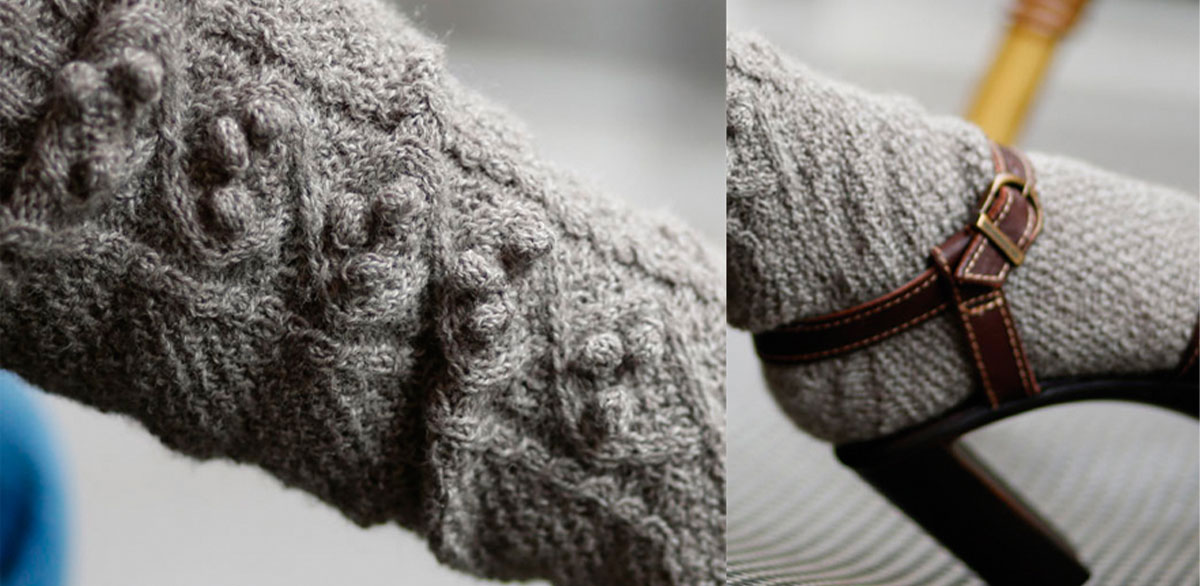
Material:
- 2 balls of Phildar Phil Folk 50 for sizes 28 through 38.
- 3 balls of Phildar Phil Folk 50 for sizes 40 through 46
- 1 set of 4 double-pointed needles or circular needles, size 2
- 1 set of 4 double-pointed needles or circular needles, size 2.5
- 1 cable needle
- Stitch Markers
- Stitch Holders
Sizes
a) 28/30 - b) 32/34 - c) 36/38 - d) 40/42 - e) 44/46
Stitches used:
- Line 2/2
- Knitwear.
-
Barley Stitch:
1st row: *1 knit, 1 purl*, repeat from * to * throughout.
2nd and 4th rows: knit the stitches as they appear on the needle.
3rd row: *1 purl st., 1 knit st.*, repeat from * to * throughout.
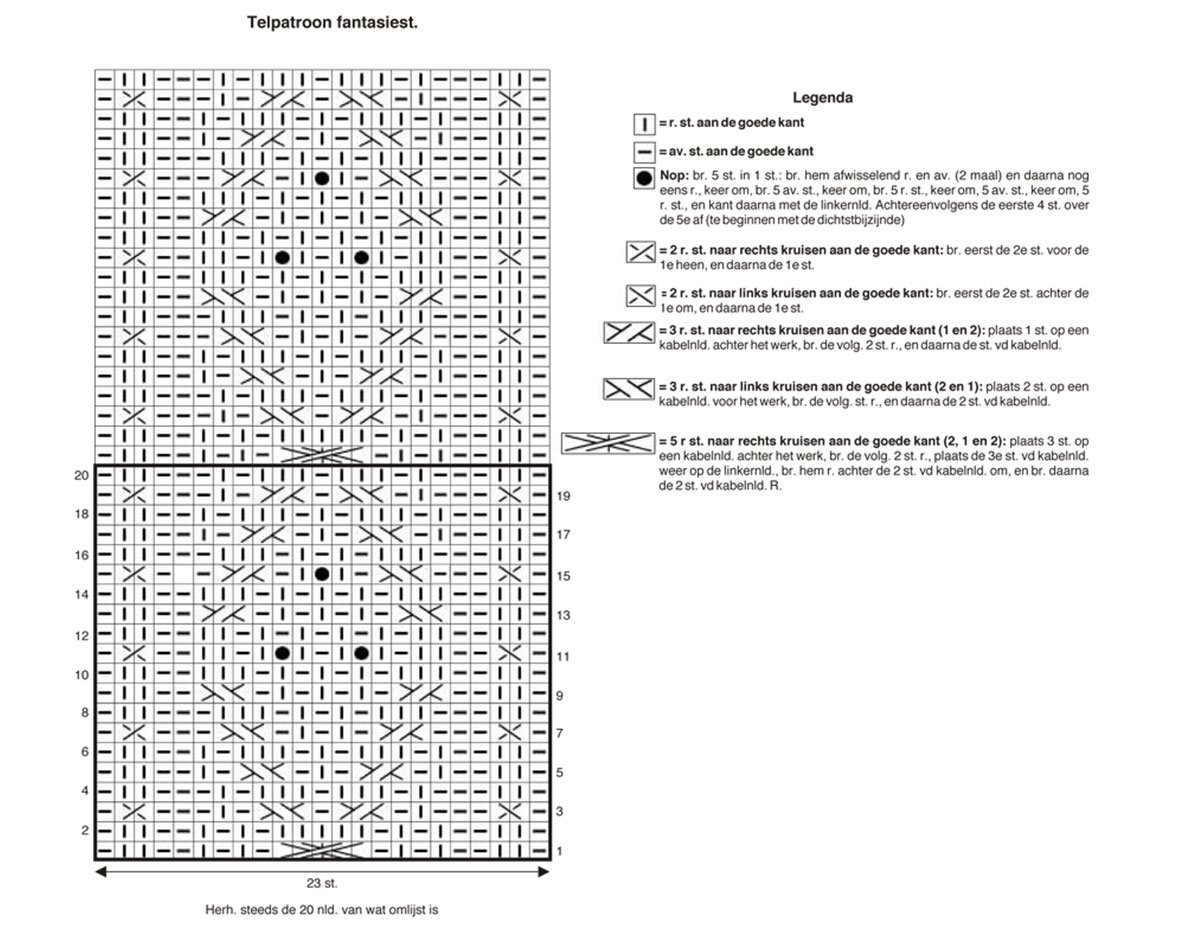
Repeat these 4 rows. So you knit the stitches in reverse order on every 2nd row. - Fantasy Stitch (see stitch pattern)
- 2 together
- Single decrease: Slip 1 stitch purlwise, knit the next stitch, and pass the slipped stitch over the knitted stitch.
- Double decrease with a marked stitch: knit across 3 sts (the marked stitch is the middle one), then knit 3 sts together or purl 3 sts together to maintain the barleycorn stitch pattern.
Gauge swatch:
10 cm in barley stitch. With needle size 2.5 = 30 sts and 45 rows. The 23 sts of the fantasy stitch, needle size 2.5 = 6 cm.
Socks Knitting Pattern:
Right sock:
Sleeve: Cast on a) 64 sts. - b) 68 sts. - c) 76 sts. - d) 80 sts. - e) 88 sts. using size 2 needles and join to form a circle; mark the first stitch of the round with a Stitch Marker or a colored thread (= center of the inside).
Work 4 cm (20 rows) in 2/2 ribbing.
Next, work as follows using the barley stitch (see stitches used) and the fantasy stitch (see stitch pattern) with size 2.5 needles: a) 21 sts. - b) 23 sts. - c) 27 sts – d) 29 sts – e) 33 sts in seed stitch, the 23 sts from the pattern, and a) 20 sts – b) 22 sts – c) 26 sts – d) 28 sts – e) 32 sts in seed stitch
Using the marked stitch (see "Stitches Used"):
a) Every 10th row: 6 x 1 double decrease.
b) every 14th row: 3 x 1 double decrease, and every 12th row: 3 x 1 double decrease.
c) every 12th row: 8 x 1 double decrease
d) every 14th row: 7 x 1 double decrease; and 12 rows higher: 1 x 1 double decrease
e) every 14th row: 3 x 1 double decrease, and every 12th row: 7 x 1 double decrease.
There are a) 52 left - b) 56 left - c) 60 left - d) 64 left - e) 68 left.
Meanwhile, at: a) 13.5 cm (62 rows) - b) 18 cm (82 rows) - c) d) 22.5 cm (102 rows) - e) 27 cm (122 rows) h. After the ribbing, work all sts in seed stitch.
At a) 15.5 cm (70 rows) - b) 20 cm (90 rows) - c) 23.5 cm (106 rows) - d) 27 cm (122 rows) - e) 30.5 cm (138 rows) after the ribbing, for the HEEL, on both sides, hold the last a) 26 - b) 28 - c) 30 - d) 32 - e) 34 sts on hold for the top of the foot, and continue working with the first a) 26 - b) 28 - c) 30 - d) 32 - e) 34 sts
Work back and forth in stockinette stitch, leaving 1 stitch on the 2nd needle on each side: a) b) 6 times 1 stitch - c) d) 7 times 1 stitch - e) 8 times 1 stitch.
When there are still a) 14 sts. - b) c) 16 sts. - d) e) 18 sts. remaining, on either side of these sts., on every 2nd row: a) b) pick up 6 x 1 st. - c) d) 7 x 1 st. - e) 8 x 1 st.
You have a) 26 points - b) 28 points - c) 30 points - d) 32 points - e) 34 points
Pick up the waiting a) 26 sts. - b) 28 sts. - c) 30 sts. - d) 32 sts. - e) 34 sts. for the top of the foot and work in seed stitch (see stitches used) in the round.
You have a) 52 - b) 56 - c) 60 - d) 64 - e) 68
At a) 9 cm (40 rows) - b) 11.5 cm (52 rows) - c) 14 cm (64 rows) - d) 16.5 cm (74 rows) - e) 19 cm (86 rows), foot height; for the TOE in stockinette stitch: a) 26 sts - b) 28 sts - c) 30 sts. - d) 32 sts. - e) 34 sts. for the bottom, and do the same for the top.
Start the row as follows: 1 st., 1 yo, a) 20 st. - b) 22 st. - c) 24 st. - d) 26 st. - e) 28 st., knit 2 st. together, 2 st., 1 yo, a) 20 st. - b) 22 st. - c) 24 st. - d) 26 st. - e) 28 st., knit 2 together, and 1 st.
Repeat this pattern on every 2nd row, keeping the stitches neatly aligned one above the other. When there are a) 8 sts. - b) 8 sts. - c) d) 10 sts. - e) 12 sts. remaining at the top and bottom, bind off using the grafting method.
Knit the left sock in mirror image.
Do you like to wear knitted socks in the winter?


